PhD, University College London
London · Email
I'm a machine learning researcher working on medical and spectral imaging. I'm currently the founding computer vision scientist at Prospectral, where I lead the machine learning work.
My PhD at University College London studied stroke lesion segmentation in clinical MRI, focusing on robustness across scanners and sequences.
Tokenizer-Generator Coupling in Medical Image Generation
NeurIPS 2026, poster · Liam Chalcroft
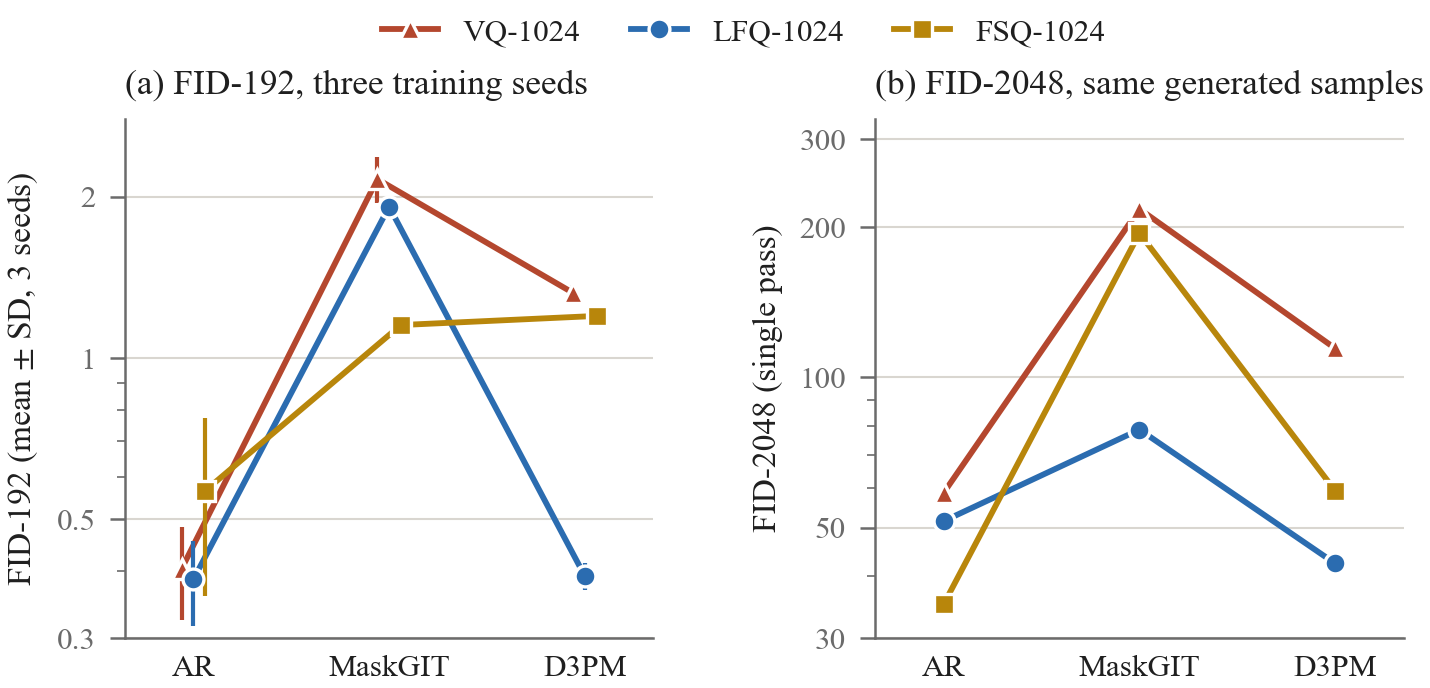
The study compares tokenizers, generators and sampler settings on ChestMNIST images at 64 by 64 resolution.
In this study, tokenizer rankings depend on the generator and sampler settings. Reconstruction PSNR alone is not a reliable criterion for selecting a tokenizer.
Unconditional 64 × 64 images, evaluated with non-clinical generation metrics.
GAZE
Duaa Alim, Mogtaba Alim and Liam Chalcroft
AIiH 2026, oral paper
GAZE lets a vision-language model inspect brain MRI iteratively, using image tools and literature retrieval. It evaluates diagnosis, localisation and captioning together on cases covering rare neurological conditions.
Retrieval effects depend on the model: gains in diagnosis can coincide with losses in localisation. The paper examines these trade-offs alongside structured prompting and tool use.
Tools and evaluation in GAZE
- Viewer tools
The model can request zoom, windowing, contrast adjustment and edge detection.
- Retrieval tools
The model can search PubMed for literature and Open-i for radiological images.
- Joint evaluation
Structured outputs are scored jointly for diagnosis, localisation and captioning.
Method overview from the public workflow documentation and paper.
Libraries I maintain and the implementations behind the research.
All code and contributionsRust, Python
Python
Python, PyTorch
Python, PyTorch
This paper studies how to schedule physics guidance in diffusion models for photonic inverse design.
Gradient-manifold alignment scheduling for physics-guided diffusion
SPIE Photonics Europe 2026
My PhD at UCL concerned stroke lesion segmentation in clinical MRI, with a focus on robustness across scanners and sequences.



Choosing a tokenizer means choosing a generator
September 2026
August 2026
Tokenizer-generator coupling, NeurIPS 2026
August 2026
Oral at SPIE Photonics Europe 2026
April 2026
Talk at yESMInar #37: AI in Medical Imaging, European Society for Molecular Imaging
April 2026
PhD awarded, University College London
2026
Self-directed multimodal AI, RCR Open 2026
2026