
Abstract. Diffusion-weighted MRI is critical for diagnosing and managing ischemic stroke, but variability in images and disease presentation limits the generalizability of AI algorithms. We present DeepISLES, a robust ensemble algorithm developed from top submissions to the 2022 Ischemic Stroke Lesion Segmentation challenge we organized. By combining the strengths of best-performing methods from leading research groups, DeepISLES achieves superior accuracy in detecting and segmenting ischemic lesions, generalizing well across diverse axes. Validation on a large external dataset (N = 1685) confirms its robustness, outperforming previous state-of-the-art models by 7.4% in Dice score and 12.6% in F1 score. It also excels at extracting clinical biomarkers and correlates strongly with clinical stroke scores, closely matching expert performance. Neuroradiologists prefer DeepISLES’ segmentations over manual annotations in a Turing-like test. Our work demonstrates DeepISLES’ clinical relevance and highlights the value of biomedical challenges in developing real-world, generalizable AI tools. DeepISLES is freely available at https://github.com/ezequieldlrosa/DeepIsles.
Year 2025Kind journal paperVenue Nature CommunicationsVolume 16Article 7357DOI 10.1038/s41467-025-62373-x
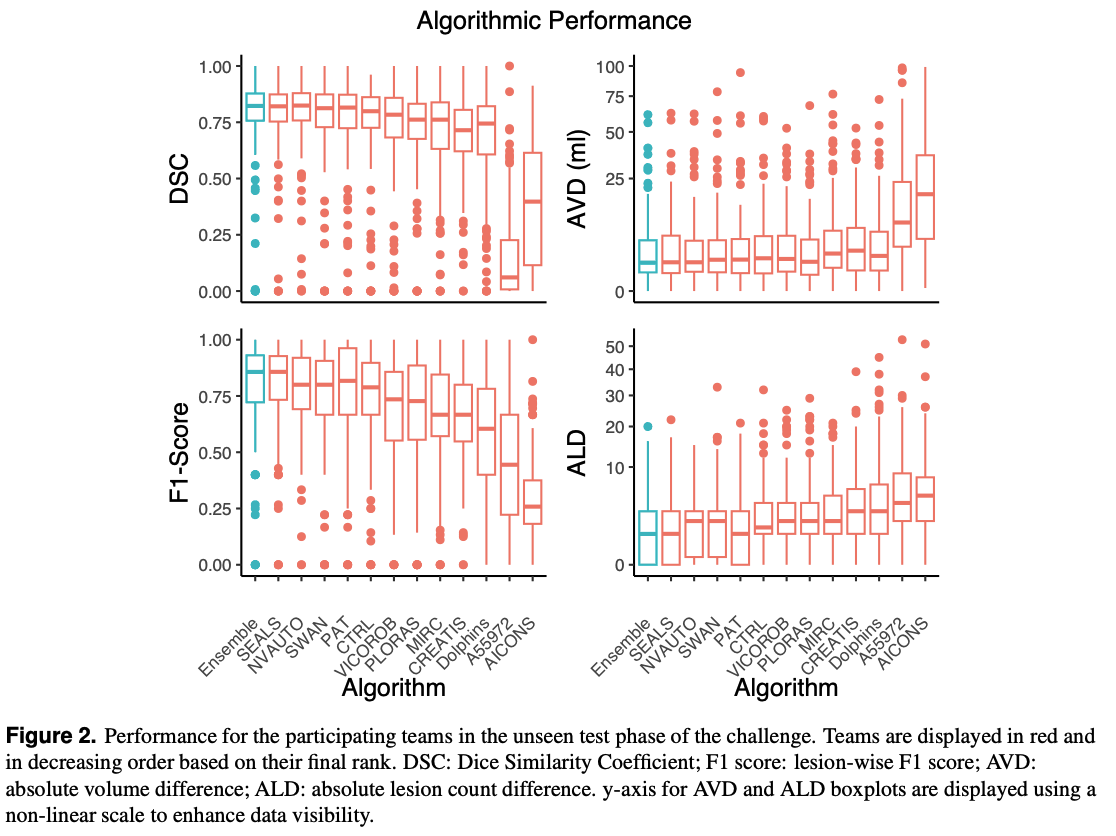
Figure 2 from the author preprint (arXiv v2, April 2024): ensemble and individual-team performance on the unseen ISLES challenge test set. This is a different figure from Figure 2 in the published Nature article.
Materials
The ensemble implementation and inference instructions maintained by the DeepISLES authors.
The Nature Communications version, including external validation, clinical associations and the full consortium author list.
@article{delarosa2025deepisles,
  author    = {de la Rosa, Ezequiel and Reyes, Mauricio and Liew, Sook-Lei and Hutton, Alexandre and Wiest, Roland and Kaesmacher, Johannes and Hanning, Uta and Hakim, Arsany and Zubal, Richard and Valenzuela, Waldo and Robben, David and Sima, Diana M. and Anania, Vincenzo and Brys, Arne and Meakin, James A. and Mickan, Anne and Broocks, Gabriel and Heitkamp, Christian and Gao, Shengbo and Liang, Kongming and Zhang, Ziji and Rahman Siddiquee, Md Mahfuzur and Myronenko, Andriy and Ashtari, Pooya and Van Huffel, Sabine and Jeong, Hyunsu and Yoon, Chiho and Kim, Chulhong and Huo, Jiayu and Ourselin, Sebastien and Sparks, Rachel and Clèrigues, Albert and Oliver, Arnau and Lladó, Xavier and Chalcroft, Liam and Pappas, Ioannis and Bertels, Jeroen and Heylen, Ewout and Moreau, Juliette and Hatami, Nima and Frindel, Carole and Qayyum, Abdul and Mazher, Moona and Puig, Domenec and Lin, Shao-Chieh and Juan, Chun-Jung and Hu, Tianxi and Boone, Lyndon and Goubran, Maged and Liu, Yi-Jui and Wegener, Susanne and Kofler, Florian and Ezhov, Ivan and Shit, Suprosanna and Hernandez Petzsche, Moritz R. and Müller, Michael and Menze, Bjoern and Kirschke, Jan S. and Wiestler, Benedikt},
  title     = {{DeepISLES: a clinically validated ischemic stroke segmentation model from the ISLES'22 challenge}},
  journal   = {Nature Communications},
  year      = {2025},
  volume    = {16},
  eid       = {7357},
  doi       = {10.1038/s41467-025-62373-x},
  url       = {https://www.nature.com/articles/s41467-025-62373-x}
}