Synthetic Data for Robust Stroke Segmentation
 Journal of Machine Learning for Biomedical Imaging (MELBA).
Abstract. Current deep learning-based approaches to lesion segmentation in neuroimaging often depend on high-resolution images and extensive annotated data, limiting clinical applicability. This paper introduces a novel synthetic data framework tailored for stroke lesion segmentation, expanding the SynthSeg methodology to incorporate lesion-specific augmentations that simulate diverse pathological features. Using a modified nnUNet architecture, our approach trains models with label maps from healthy and stroke datasets, facilitating segmentation across both normal and pathological tissue without reliance on specific sequence-based training. Our method achieves robust out-of-domain performance where conventional approaches fail, with in-domain performance of 48.2% Dice compared to 57.5% for conventional training. Crucially, even with oracle knowledge of the optimal domain adaptation method - an unrealistic scenario in practice - conventionally-trained models cannot match our synthetic approach in out-of-domain settings. The framework demonstrates that synthetic pre-training provides fundamental robustness unachievable through test-time adaptation alone. Our approach reduces reliance on domain-specific training data and helps bridge the gap between research-grade and clinical scans to improve clinical stroke neuroimaging workflows. PyTorch training code and weights are publicly available at https://github.com/liamchalcroft/SynthStroke, along with an SPM toolbox featuring a plug-and-play model at https://github.com/liamchalcroft/SynthStrokeSPM
Year 2025Kind journal paperVenue Machine Learning for Biomedical ImagingVolume 2025Article 2025:014Pages 317-346DOI 10.59275/j.melba.2025-f3g6
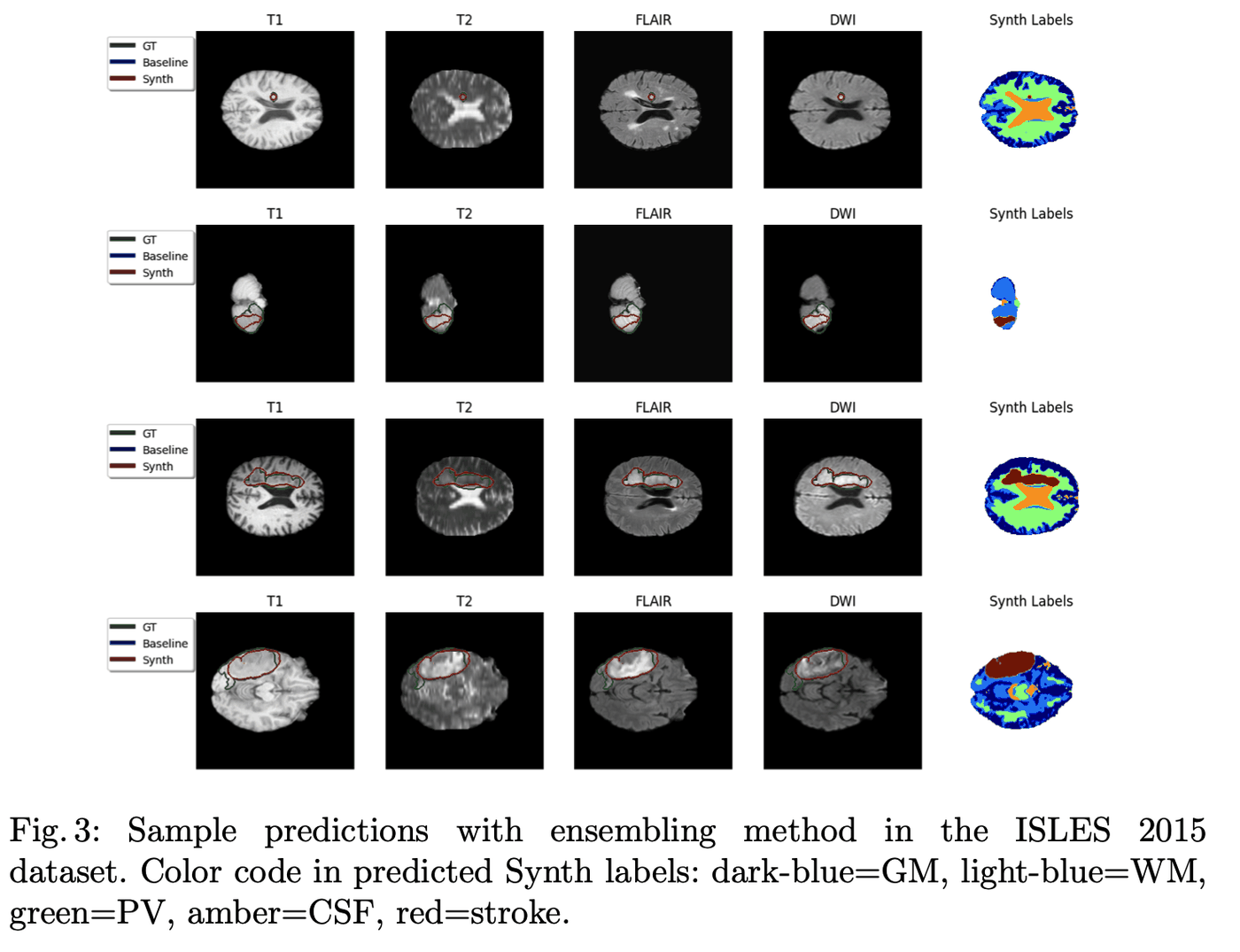
Figure 3 from the earlier author preprint (arXiv v1, April 2024): example predictions across MRI sequences in ISLES 2015. This figure predates the published journal version linked above.
Materials
Training code and model weights
PyTorch implementation of synthetic stroke training and the released segmentation model.
MATLAB/SPM interface to the model, with installation instructions for using it without a Python environment.
Read the in-domain and out-of-domain comparisons together; the reported robustness gain does not imply higher in-domain Dice.
@article{chalcroft2025synthetic,
  author    = {Chalcroft, Liam and Pappas, Ioannis and Price, Cathy J. and Ashburner, John},
  title     = {{Synthetic Data for Robust Stroke Segmentation}},
  journal   = {Machine Learning for Biomedical Imaging},
  year      = {2025},
  volume    = {2025},
  eid       = {2025:014},
  issn      = {2766-905X},
  pages     = {317--346},
  doi       = {10.59275/j.melba.2025-f3g6},
  url       = {https://www.melba-journal.org/papers/2025:014.html}
}