Tokenizer-Generator Coupling in Medical Image Generation
Advances in Neural Information Processing Systems (NeurIPS) 2026, poster.
Reading the results
The tokenizer, generator and sampler jointly determine the ranking. The three-seed vocabulary-1024 comparison tests whether the interaction persists across training seeds.
The study concerns unconditional 64 × 64 medical-style images and non-clinical metrics. Continuous references were not given an equivalent sampler sweep.
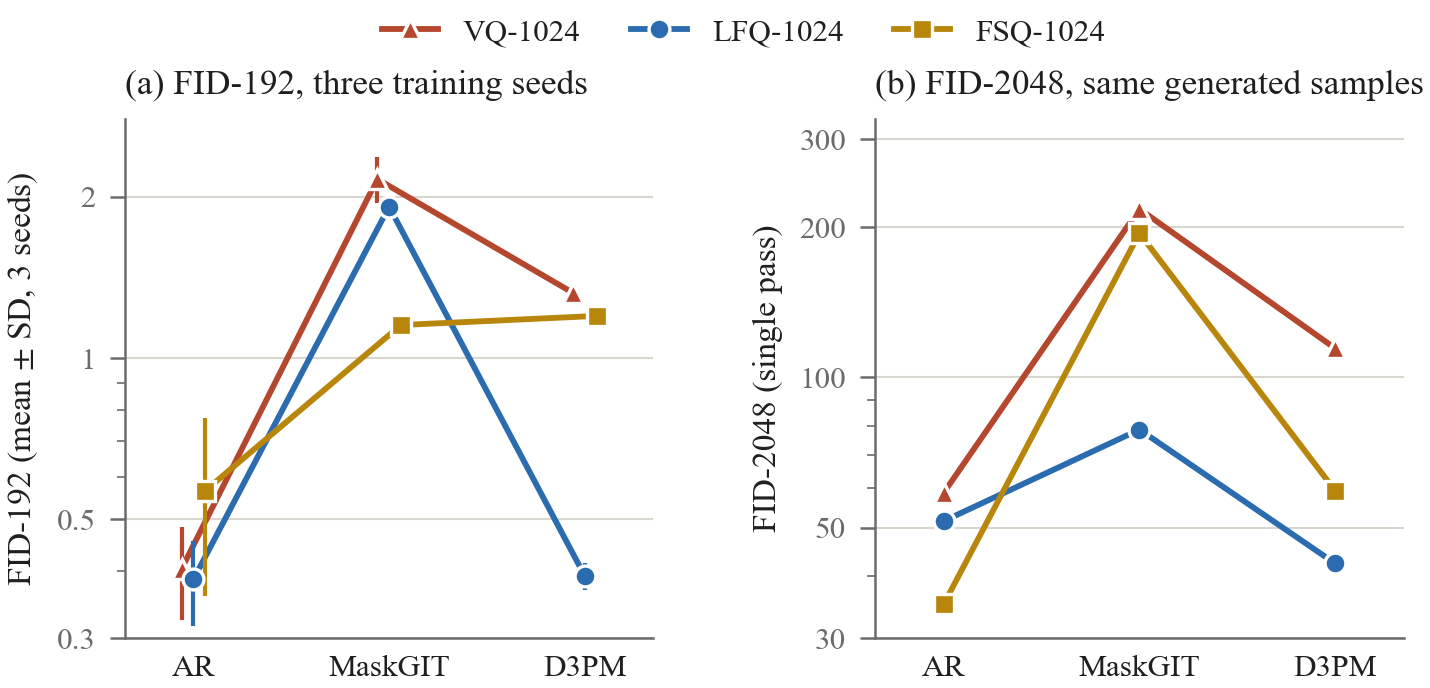
Abstract. Latent medical image generators usually treat the tokenizer as fixed preprocessing. We test whether this separation holds in a controlled ChestMNIST study at 64 × 64 that crosses discrete tokenizers, generator families, and sampler settings under a shared latent grid, with continuous-latent reference cells. The rankings depend jointly on the tokenizer, generator, and sampler. The best quantizer changes with the generator, and validation-based sampler selection changes the apparent generator ranking. We interpret this through a rate-distortion-modelability framing in which modelability is conditional on the generator, sampler, and inference budget. The interaction persists when the vocabulary-1024 block is retrained at three seeds, with 4 of 9 pairwise quantizer comparisons exceeding three seed standard deviations, including a reversal between LFQ and FSQ from MaskGIT to D3PM; the rest of the grid was trained at a single seed and is correspondingly less certain. Reconstruction PSNR alone is not a reliable selection criterion. On LFQ-1024, retuning the D3PM and SEDD samplers on a held-out validation split reduces FID-192 from 0.44/0.41 at the default budget to 0.09/0.10 at lower NFE, replicated across seeds, although the continuous references were not given an equivalent sampler sweep. FID-192, our internal ranking metric, ranks consistently with standard FID-2048 (Spearman 0.89) and with a label-free classifier two-sample test (0.86). All experiments are unconditional, use low-resolution 64 × 64 medical-style images and are evaluated with non-clinical FID-based metrics, and our claims are limited to that setting. Implementations are released at https://github.com/liamchalcroft/medtokenizers and https://github.com/liamchalcroft/medlatents.
Year 2026Kind conference paperVenue Advances in Neural Information Processing Systems (NeurIPS 2026)
Materials
Experiments, results and figure scripts
The controlled tokenizer-generator study and its stored result data. Most cells have one training seed; the vocabulary-1024 block includes the multi-seed comparison.
Discrete and continuous medical-image tokenizer implementations used by the study.
Generative model families over tokenised images, including the samplers whose settings affect the reported rankings.
The current author manuscript. Results concern unconditional 64 × 64 images and non-clinical generation metrics.
@inproceedings{chalcroft2026tokenizer,
  author    = {Chalcroft, Liam},
  title     = {{Tokenizer-Generator Coupling in Medical Image Generation}},
  booktitle = {Advances in Neural Information Processing Systems (NeurIPS 2026)},
  year      = {2026},
  url       = {https://arxiv.org/abs/2608.07713}
}